
New World a-Coming, Ch. 13
The Bassanda National Radio Orchestra

A few weeks after the Rexroth reading, and the Oakland trip where I met up with the Panthers for the first time, Etsy said to me, “Yezget-Bey’s decided that if you want to think about writing a story about the Band, he wouldn’t object. He figures you’ve been around us long enough, and I think maybe he wants to find a wider audience.”
So I went with him, the next day, to the Band house. A lot of the Frisco groups were doing that, not just the Dead who we’d heard about, but also people like Chet Helms’s Family Dog, and the Charlatans—who were actually up in Virginia City, too: they were kind of the progenitors of that back-to-the-land thing that came later.
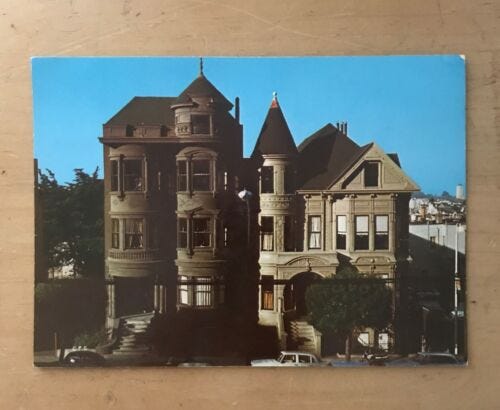
The BNRO’s house was one of those run-down painted ladies—tall and narrow and three stories. There were a lot of those available cheap, between the Mission District and the Panhandle end of Golden Gate, in those years. Nobody had any thoughts of buying up real estate; they just liked the rents, and the landlords mostly left them alone, and the tenants didn’t or couldn’t really care that the windows and the roofs leaked or that the hot-water boilers regularly gave out. Looking back, it was kind of idyllic and also kind of naive: almost everybody wound up with lice or the clap, and any cleaning that got done, the women usually did it. It was before any of the bands were making much money, and so they weren’t thinking yet about getting out into the hills and “homesteading”—or that’s what they thought it was. And when they did head for the hills, it was still mostly the women who did the cooking and the cleaning.
I found out later, though, that Yezget-Bey didn’t really want the Band too close to the Haight. He liked the street culture, but I think he figured out, a lot earlier than a lot of others, that the neighborhood was going to be dangerous, too, and he was acutely conscious that the Band’s work visas might not totally hold up if the Man wanted to get too inquisitive.
So he’d found a place up on East Fulton near the USF campus, north of the Panhandle. That put them close enough to the Haight, but also gave Yezget-Bey access to the university’s libraries—he’d wangled some kind of special access. It was near the bus lines for the Bay Bridge too, and he liked being close to St Ignatius church, who let him use their basement for band practices, though I could never figure that out quite why, because he sure wasn’t Orthodox religious. Maybe he had contacts there, I don’t know.
The house itself wasn’t that exciting—just another run-down three-decker that could have been student housing—but when Etsy brought me there on that sunny Tuesday morning in September, I noticed a few things immediately: though the paint was peeling and you could see the asphalt shingles over the dormers flaking off, the windows were clean, and there were flowers growing in the postage stamp-sized front yard. The front door was ajar, and I noticed a lot of sleek, well-cared-for cats, too.
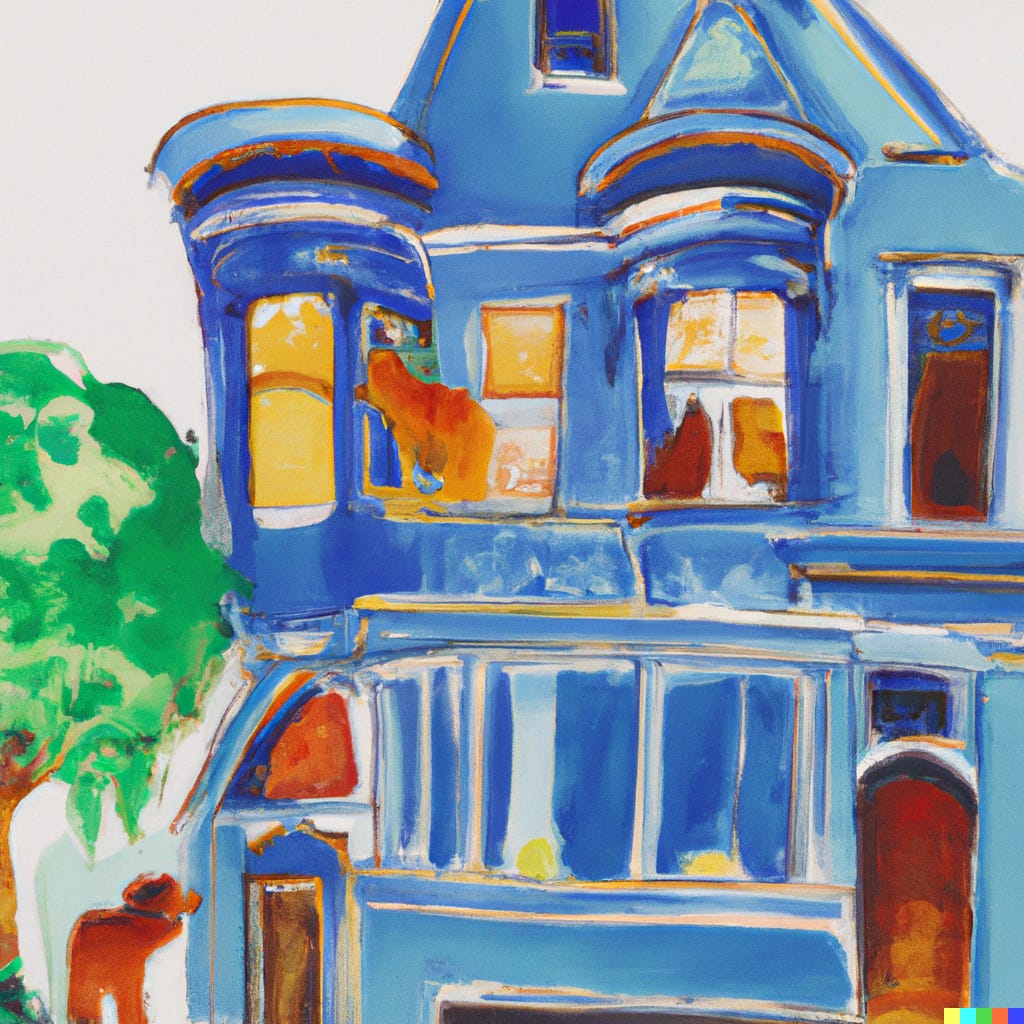
The house was pretty tall, about three stories, but probably only about 18 feet wide—San Fran was another one of those towns with old property laws, that taxed you on the frontage, so most of the building lots were narrow and deep—and when we went inside, it was a steep staircase, to the right, and landings that opened out to various rooms on the left. Being built on a fairly steep slope, the house had a cellar to one side that went down steep wooden steps, underneath the staircase.
Inside, it was dim and cool, and unlike a lot of the heads’ houses, it didn’t smell of weed and mold. There was incense smell—that part at least was familiar from the band houses—but you got amazing cooking aromas, as well. Upstairs, you could hear musicians practicing, and there was a tow-headed little boy in the downstairs front room, with the bay window that overlooked the steep street; he was playing a portable pump organ, and there was a little girl sitting on the floor, pumping the bellows pedals that the little boy’s feet wouldn’t reach from the organ bench. He was pretty good, too.
Etsy nudged my elbow, and led me along the creaking-floored narrow ground level hallway, through the house and the back kitchen, and out into the back garden, between head-high brick walls. Even though there was a pretty good breeze coming off the water to the west and north, the walls held in the sun’s heat and cut the wind; Yezget-Bey, who was bent over a big flat table covered with oversized sheets of music manuscript paper, didn’t even have to weight them down. He didn’t look up when Etsy opened the kitchen door and we came into the garden, but kept marking the paper with a thick black pencil.
The same girl was sitting in an Adirondack chair beyond him. She was facing the kitchen door; she had a flute across her lap, and she was holding a single sheet of manuscript paper. She looked up sharply at the sound of the door, but when she saw it was us—or, maybe, me—she got up abruptly, made a wide berth around me, and went back into the house.
Etsy behaved as if he hadn't even seen her, and then when Yezget Bey spoke to me I got distracted pretty quickly. I thought I was going to interview him about the band but it turned out that he really wanted to ask me about my own background and about places I knew around the city and up around Northern California where the band could play. We talked for a while, about the Oracle, and what it had been like in San Fran the year before, when I first got there, and I did get to ask him some of the questions about the band's origin in the Bassanda satellite, even though I barely knew where that was. To where that was. Honestly, I wasn't even sure that I'd wind up getting something that I could use for a story, but he was so interesting to talk to, and he had so many anecdotes about traveling in Europe, even behind the Iron Curtain, that I really just wanted to sit and listen to him.
Later in the afternoon, when it started to get chilly in the back yard, he and Etsy took me to a rehearsal in the St Ignatius basement, and I got a little fuller sense of the group and who all was involved. They didn't really sound very much like the San Francisco bands: usually with them, you could tell which ones had been folk musicians or which ones had played or even the ones who were just learning to play their instruments ; sometimes the ones who were the most popular bands were more popular because of the clothes that they wore or the chicks up front.
They had a lot of instruments that you didn’t much see locally, as well: La Danseur played flute, but they had a couple of cellos, and some brass, and a bunch of saxophones. And they had this one kid, couldn’t have been more than 15 years old, who played about six different instruments, and was a great acrobatic dancer, too—in fact, Grogan and the Diggers tried to steal him away, just because he was so good with the spectacular street performance stuff, but he just wanted to stay at the band house and practice.
And they had a larger percentage of women than a lot of the other groups, too. I mean, there were chick singers in Big Brother, and the Great Society, and a few others, but we’re talking, like, over half the players in the BNRO were women, and a lot of them were in leadership positions; Szabo was the concert master and led the full band, and there were a bunch of girl singers and dancers, but they also had a girl—sorry, a woman—named Aisha leading the saxophone section, and another really exotic-looking chick named Caitriona—though she didn’t look like any Irish girl I’d ever met before—leading the French horns. And some of them, I honestly wasn’t quite sure if they were guys or women: I mean, the squares always said that longhaired guys looked like faggots or girls, but with the BNRO, it really was kind of fluid: you couldn’t always tell.
They were all actually pretty respectful; unlike a lot of the hippie bands, chicks got a say in musical decisions, and like I said, a number of the different sections actually had women leading them. And they had that thing that hippie guys—even guys like me who weren’t really trying to get in bed with them—couldn’t really fathom: you got the sense that these women could lead—like, not just in music, but in other things too.
I think at least a couple of them were homosexuals—sorry, I know that’s not the word we’re supposed to use anymore, but we didn’t know any other word to call ourselves—and they weren’t anywhere near as shy about it. There were definitely guys in the San Fran bands who liked men, but, unlike the poets in North Beach, the rock & rollers were mostly way too scared and middle class to let the square world know that. I was kind of coming to terms with it in myself, and maybe because I was a little older, and had been in San Fran a little longer with the poets, I wasn’t quite so ashamed—though I still wouldn’t have wanted my folks back home to know.
Several women in the Band were interested in me, maybe—they were strong women, and they weren’t shy like American girls, even the hippie girls, about saying if they wanted to sleep with you—but that wasn’t really who I was, or what I wanted. Who I really wanted was Etsy: the first from the Band I’d met, the one I knew best, the most beautiful of them all. But though he was always gentle with me, and I never got the sense that he was judging me for the fact that I preferred men, he never gave me even a hint that my obsession with him might work out. He kind of treated me like he was an older brother, or maybe a mentor.
But I wanted more. So much more.