
New World a-Coming, Ch. 15
1967: Not to be.

And then at the end, as the Band trooped off stage and Big Brother was coming on—where I knew that they’d spend 10 or 15 minutes tuning, with the amps hissing and crackling behind them, I tried to find Etsy. I just couldn’t stand not telling him anymore.
So I went along one side of the stage to the door which had formerly led behind the big screen; now it was just the passageway that ran from one side, with access from the floor, toward the dressing rooms at the other corner. It was almost pitch dark, with just a little bit of leakage from the doors at either end. But then a voice spoke out of the darkness and a pale face loomed up just in front of me: the cellist Elzbieta, standing there in the shadows, the neck of her instrument held in one hand at her side. I almost ran into her. I had never spoken to her, and truth be told I was a little bit afraid of her: she always dressed in black clothing, , and it made her pale, pale face look even whiter. She had dark, dark eyes and she never smiled, even though she never seemed unfriendly. Now, standing there in the darkness behind the stage, it felt almost as if her face was floating disembodied in the shadows. As she looked up at me, I caught a little bit of a red glint behind the blackness of her pupils.

Even though I had not spoken, she said to me, in her indefinable accent, “What is it, young man?”
I don't know why she called me young, though she had always seemed much older than I was myself, even with her flawless skin and youthful stately movements. For a moment, and unexpectedly, I felt taken aback; it was as if she was asking me about something I had concealed even from myself.
I didn't answer, and then for the first time ever, I saw it just a hint of a smile from her; but though her eyes in the darkness were shaded, she seemed sad. She said, “Life is so very short, for most; do not mourn that which does not happen. These things pass, young man. We feel them, and then time intervenes, and then we feel different things. Go and find him if you must, and tell him what you feel, so that you have said it aloud. But do not expect anything, for good or for ill.”
For a moment, she lifted her left hand, and gently stroked my cheek. Her touch was infinitely light, though her cellist’s fingertips were calloused and rough as leather. Then she laid her soft, smooth palm against my face—and it was icy cold.
She said again, “Life is short, child. Do not give too many of those fleeting hours to regrets for that which cannot occur.” Then she stepped back, and her face vanished into the darkness like a candle flame blown out by a breath of night air, and I was standing there alone, feeling cold all over.
I didn’t give up, though: I tried to find Etsy backstage. I think I hoped that I could ride along with him in one of the band cars; at least I could be near him and maybe being next to him would help me find the courage to say what I felt. But he had already departed, I guess; I looked for him, jostling my way through the crowds, first backstage with all the types the types who hung out, and then in the midst of the tumult of Big Brother's set.
It was kind of like a nightmare: I felt as if Elzbieta had given me permission to talk to Etsy, but now, like a nightmare, I couldn't find him. Finally I gave up, and I rode back to the band house with Yezget Bey and the older man Robin. They offered me the ride, and I curled up in the back seat of the big old sedan that Yezget-Bey was driving that year, but I didn't take part in their talk. A lot of it was in Bassandan anyway. When we got to the band house on East Fulton, I felt so trapped, so miserable, that even though I didn't know what I would say, I decided I would go and find Etsy even so.
There were always people awake there, though late at night they tried to be quieter so the kids could sleep; there was a lot of hanging out in the overgrown weedy back garden where I'd first met Yezget and crossed paths again with La Danseure. Now it felt familiar, but among the smokers who were talking quietly in the backyard, coming down from the gig, Etsy was nowhere to be found. I went back into the House and, and drifted along the corridors, floor by floor, peaking in one open door after another. I didn't have the nerve to knock on any closed doors, but I guess I thought but maybe I would just find him and be and maybe I would just find the words to say. It took a long time.
Finally I found him near the top of the house, sitting in one of the dormer windows under the eaves, looking west toward the Golden Gate and the moon that was riding down toward the horizon over the Pacific. I came up the staircase, and there he was, his white hair and beard touched by the moonlight. and he was so beautiful that I almost couldn't speak. At the sound of my feet on the stairs, he turned his head and smiled at me.
“Still restless, Little Bear?”
I didn't speak, but sat down on the floor next to him. I wanted desperately to lean my head against his knee, just to feel his touch, but I didn't dare. I could smell the aroma of his tobacco, and beneath that of his skin. After a minute, he put one hand down on my shoulder, and pulled me against his knee, and we sat there for a few minutes. My mind was spinning, and I was trying to think of the words to say. But in the end, he spoke first.
“You're a good man, Little Bear. You try to do the right thing, to tell the truth and to be kind. You're a man who deserves love. And you deserve to be happy, in the ways that are right for you.
“But I'm afraid it's not with me. I have a heart, but it lies elsewhere and I'm sad that it can't be with yours.”
My eyes filled with tears, and I couldn’t breathe very well. We sat there, him turned sideways, with one foot up on the window seat; me on the floor beside him, feeling the warmth of his knee and thigh against my shoulder. My eyes stung.
We sat for a long time. I was trying to think of words I could say, that would make him understand how much he meant to me, and how much I loved him, and how much I thought I couldn’t bear to be without him. Time passed. Finally the words in my head stopped spinning, and I was just sitting there, listening to him breathing quietly and slow.
Finally he stood up from the window seat, and held out a hand, pulling me to my feet also. I found myself standing closely to him, and realized—even now, after the weeks I had spent near him—that he was taller and wider than I. He turned his white-maned head to look at me, and leaned close; for a moment, I thought he was about to kiss me, and my heart leaped. But instead, he clasped the back of my neck with one of his rough warm hands, and pressed his forehead against mine; I felt his breathing in tandem with my own.
Then he stepped back, and kissed me on the cheek, and then he turned and left me, standing there in the dimness.
Much later—I don’t know how I got there, but some amount of time later—I don’t know how long—I found myself crying, hunched over on the retaining wall in the alley behind the house. It was dark, and it smelled like garbage from the trash cans, but I didn’t care. I don’t know how long I sat there, but I cried until I couldn’t cry anymore. I could hear the house’s back door, the one that led down to the cellar where they stored the instruments, banging open and shut, and Bassandan and American voices talking, but even when I wasn’t crying anymore, I couldn’t face them. Couldn’t face him. I just sat there, in the smelly damp dark, and wished that my life could be different.
And then, some time after that, I don’t know how long—I might even have fallen asleep, sitting up—La Danseur was there, leaning against the wall of the house. She was staring out into the darkness, not looking at me. I saw the tip of her cigarette glow for a minute, as she inhaled, and then its arc as she crossed her arms, the cigarette between her fingers.
“Let me know when you’re all cried out, boy. I’ll wait.”
I had to clear my throat before I could reply—I’d been silent and crying for too many hours—but finally I said, “This is personal. I’ll carry it for myself. It’s nobody else’s business. Not yours either.”
She tsked impatiently and her cigarette butt landed on the dirty asphalt in a shower of sparks, before she ground it out under one toe.
“Oh, for god’s sake, m’petit chou. It’s obvious you want him, and it’s obvious that he’s not going to sleep with you. Don’t get all doux about it. Yes, he’s a beautiful man, but he’s not for you or for me or for any of the other girls or boys in the Band. You can’t win his heart: his passion is for Bassanda. You should look for love somewhere else.”
Even though I tried to hide it, I could feel my eyes stinging with fresh tears. I looked away. After a moment she sighed, and then she came and sat next to me on the retaining wall. She put one arm around my neck and pressed against my side. “It’s OK, canard. Everybody has these passions, and we all learn to survive them and look elsewhere. I know it’s harder for you when it’s another man, but we women suffer through it too.”
She rubbed her cheek against mine; I could feel the softness of face, even through my beard, and she smelled musky and warm. After a few moments she stood up, stretching her back and looking up at the few faint stars in the pale sky, now winking out as the sky paled to the east, beyond the garden wall. Against the glow of the street light, at the end of the alley, I saw her small breasts, silhouetted under her thin cotton shirt.
Then she turned to me, her face in shadow, and held out one hand palm-up; I took it.
She bent down toward me, her long straight black hair falling over her shoulders; her face was in shadow, as she leaned in close. She cupped a gentle hand against my cheek, and leaned still closer, and brushed her lips lightly against mine. Her breath was sweet.
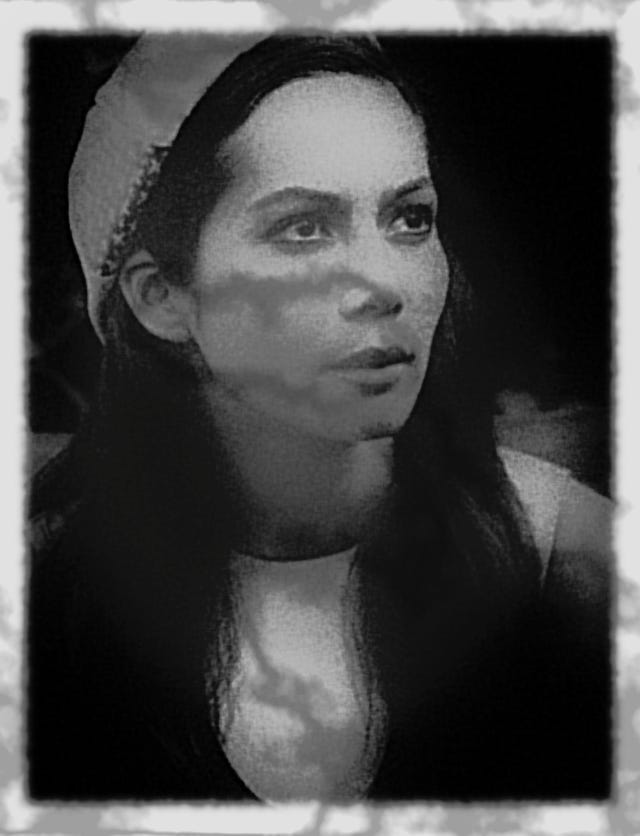
She said, in a quiet, matter-of-fact tone, “I’ve no grand passion for you, loulou, and I don’t expect that you’ll get over Etsy any time too very soon, but I like you, and I’d like to make you happy. So come on upstairs and I’ll hold you.”
And then it was the morning of the next day.