
New World a-Coming, Ch. 29
Covert resistance in occupied Ballyizget, 1939

The earliest roots of Cell #1 significantly predate its recognition as a paramilitary force during the days of the imperialist German and then Soviet occupation of Ballyizget between 1941-1948. They emerge from much older traditions of anti-Tsarist women’s and peasants’ resistance, which historically and most often took the “soft” resistance avenues of sabotage, work stoppage, and asynchronous attacks on infrastructure—especially communications and news gathering. In any era and under any occupying regime, any factory or farm manager stationed in Bassanda as part of that occupation learned to avoid committing to specific deadlines or productivity metrics—because no sooner would those targets be publicized than inexplicable new slowdowns, lost or broken equipment reports, and accelerated pilfering would combine to render the deadlines unmeetable.
Most of the Bassandan resistance, both male and female, preferred to operate from the hills, both because those distant and unmapped encampments were operationally more secure, and because putting geographical distance between resistance fighters and their friends and families tended to keep the latter safer from reprisals. However, some of the most necessary work—monitoring troop movements, destroying military infrastructure, and maintaining and extending the escape lines for allies, foreign fighters, and those compromised by the secret police—had to happen in the cities, and particularly in the capitol: as the General put it, “If you’re going to destroy the enemy, you have to be where he is.”
As a result, some of the most significant resistance actions of the period 1941-48 were undertaken by the members of the seminal organization called “Cell #1,” whose roots lay in the anti-Tsarist campaigns of the pre-World War I period. Members of that Cell appear in various accounts of that earlier period (see THE GREAT TRAIN RIDE FOR BASSANDA and BASSANDA AND THE BOLSHEVIK REVOLUTION, elsewhere in the Correspondence), and even Nazi counter-insurgency was aware of its existence, from 1939 onward. Operational security was thus a literal matter of life-and-death, and continued activity as part of the Cell contained the constant threat of betrayal and death. The circumstances thus demanded from these women, many of them mothers or otherwise part of extended caring families, extraordinary and undaunted courage.
They included:
[From the Bassandan Dictionary of National Biography]
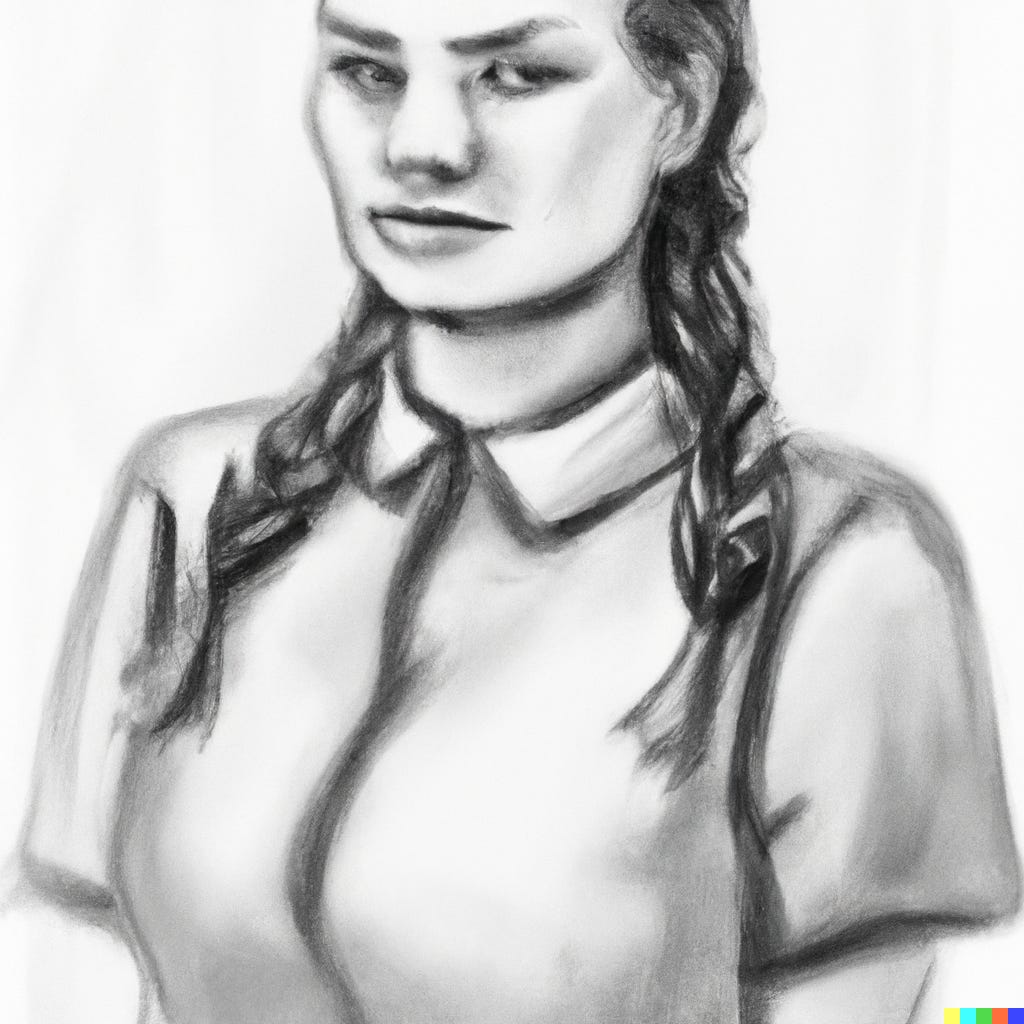
The dancer and ethnographer Ана (“Ana”) Ljubak de Quareton, born c 1920 in Hudson’s Bay of Scots, English, Norman, Abenaki, Bassandan ancestry. Other more fanciful explanations of her origins have also been ventured, and the wildest tales told, by some in the BNRO orbit. It is confirmed that one branch of her family left Scotland after the Clearances, settling first in the Presbyterian Plantation of Ulster, and then traveling on to the New World, where they homesteaded on the Old Frontier around the eastern Great Lakes. A “Peter Wharton” served in September 1814 with the American militia, consisting in large measure of Scots Gaelic immigrants, who defended Plattsburgh NY on Lake Champlain from simultaneous assault by a British squadron of gunboats and a force of about 11,000 British infantry. During the battle, the British were defeated both by sea and by land, and the retreating infantry, fleeing north toward Canada, told tales of being hunted through the midniht woods by howling clansmen and “a gigantic silver wolf.”
Ana herself appears on the Bassanda horizon well before then, in the early 1940s. During the cultural onslaught of the Nazi and Soviet wartime occupations of Bassanda, not only urban and bohemian but also rural and indigenous cultures experienced tremendous damage: minorities were uprooted, subjected to ethnic cleansing or pogrom, forbidden the traditional languages and festivals, and by-and-large forced underground. The Iliot shamans, whose practices were not only spiritual but also cultural and psychological in nature, were particular targets; many fled Bassanda entirely, others took refuge with partisans or resistance bands, still others “converted” under duress to socialist materialism. The Polish and Czech levies of the 3rd Panzer Division, who occupied Ballyizget under SS command between 1939-45, wore the Wolfsangel badge associated with Nazi collaborators elsewhere, but the symbol was regarded as particularly blasphemous by Bassandan patriots, precisely because of the wolf’s sacred stature in Iliot mythology. In the savage war of occupation fought between the occupiers and the various resistance groups collectively called Pădure Fraților (“Forest Brethren”), it was not entirely uncommon to find the Bassanda character for “wolf-spirit” cut into the foreheads of fallen Nazi troopers. And in 1941, during the brief occupation of Matthias’s Mountain Rest by Nazi Chetnik troops, in the immediate aftermath of the blizzard and lightning storm that wiped out that garrison, partisans found huge wolf prints, which followed the few escapees’ ski-tracks before disappearing into the fresh snow of the avalanche that had buried the last survivors. Tales told around the fire at the Mountain Rest suggested that the would-be escapees had fled precisely because they heard a “gigantic wolf” howling just outside the barred timber doors…
The story becomes even more complicated when examining certain historical photographs held in the Archives at Miskatonic U. In the section of sketches, ambrotypes, and daguerreotypes (sadly, not available online, as the Archive has as yet been unsuccessful in raising the very substantial funds necessary to catalog and digitize the extensive collection), there is a charcoal sketch attributed to Giyanlakshmi Julāhē Kaur. This sketch matches an anonymous ambrotype, found in a Taos mission, of the mysterious “1885 Band”—mysterious precisely because, though a very imperfect and ambiguous image, it appears to have been taken in London or possibly Paris, and to include, c1885, portraits of individuals who were likewise members of the Bands of the 1950s and ‘60s. Though denounced by 1960s BSSP functionaries as “mere imperialist falsifications”—an allusion to the poorly-retouched file photographs which notoriously “erased” discredited Party functionaries from May Day and Lenin’s Tomb commemorations, or added newly-favored ones—no persuasive debunking of the sketch, or of the ambrotype upon which it is based, has been tendered. And, equally unlikely, in addition to those paradoxically youthful-looking “later” members of the BNRO, both Madame Nijinska (not yet born in 1885) and Ana herself appear—and it is definitely the latter: her sleeveless costume reveals the Tlingit wolf on her left shoulder…
More plausible is the suggestion that Ana may have met both the General and Saadiqhah 'Ahmar, mother of “Red John” Ericsson, as a member of the Abraham Lincoln Battalion in Spain in 1935 or ’36, during the Spanish Civil War; both are documented as present in Iberia at that period. George Orwell provides a sketch of her as an unnamed “militia woman” who helped him learn how to roll his kitbag at Barcelona in 1936; in fact, these meetings, possibly during the defense of Gijon, may have led Ana to the escape routes that eventually took Orwell back to England, and ‘Ahmar to Bassanda.
She is documented in Ballyizget by the late Spring of 1939, only a few weeks after the Nazi Anschluss had invested the capitol: a blurred snapshot, taken in a café in the artists’ Quarter, shows a group including Ana, the mechanical “boffins” Anthea Habjar-Lawrence and her sister Miriam Smythe, the organist and folklorist Alexei Andreevitch Boyer, Terésa-Marie Szabo, and Yezget-Bey himself. This would have been one of the earliest meetings of the reconstituted “Cell #1,” the mostly-female underground liaison group which coordinated anti-Occupation activities between university folklorists, urban saboteurs and forest partisans, and which paid the price—several of those depicted did not survive the War (the parents of the Srcetovredi Brothers, for example, were “disappeared” only a few weeks after the photograph was taken).

The dancer Sionainn “Boudicca” Biraz de St-Denis, later of the Thirteen Wise Companions contemporary dance troupe convened by Madame Nijinska in Bedfordshire in the 1950s, was born on the outskirts of Ballyizget in 1937. Her mother became a member of Cell #1 in early 1944, at a time when that woman-centered underground group of Resistance fighters had largely converted from sabotage of the retreating Nazis, and was turning to meet the new threat posed by the Soviet “liberators.” Eventually, however, her mother was exposed to the AGB (the dreaded Agentstvo Gosudarstvennoy Bezopasnosti, the Bassandan Stalinist secret police) and was killed in custody.
Thus orphaned, in 1943 Sionainn was recruited at the age of six into the junior choir of the Bassanda Youth Orchestra, which had been formed by Madame Szabo in 1938 just before she met Nas1lsinez, to serve not only as a performance organization but indeed a children’s group home; as elsewhere in the colonial era, and especially in the Black Atlantic, music and culture organizations in Bassanda became core thematic organizations for larger community self-help initiatives. “Boudicca” (called after the British warrior queen) would continue her mother’s work with the women of Cell #1 (“My aunties and my sisters,” she called them) for decades, and thus largely “grew up” within the context of the extended tribal family of the BYO.

The dancer and visual artist Emmiana Garrett Danesi, b1924, became a member of Cell #1 at the age of sixteen. During the Nazi and then Soviet occupations, while looking like a street urchin she could pass unnoticed through Army and secret police lines where a more mature Bassandan might have excited suspicion. In April 1945 she led a squad of Bassandan saboteurs who slipped into the city to disable trucks and trams earmarked for use by Nazi troops fleeing the advancing partisans.
Džonatan Výrobca (alias?) b c1920; assassin in WWII-era Ballyizget
[No image available]
For there was more to him than the typical DP. Documents from his wartime record in the Correspondence, still embargoed since the fall of the Bassandan Communist Party, are alleged to link him to the legendary Cell #1, the urban resistance group founded c1939 by Ана (“Ana”) Ljubak de Quareton, Kristina Olenev, and Terésa-Marie Szabo, and operating clandestinely in Ballyizget, as liaison to the partisan guerrillas of the Forest Brethren. He appears to have been brought into contact with the women of the Cell through Jēkvēlina Vovk, a dancer and later kolo player and visual artist, and to have lent his expertise to the nascent Bassandan Bicycle Corps as they developed anti-imperialist motorcycle-sabotage techniques.
[See the entry “Výrobca, Džonatan,” in the redacted volumes of the Bassandan Dictionary of National Biography]