
New World a-Coming, Ch. 25
Bassandan Iconography

From the Matthiaskloster Grimoire
Bassandan Iconography, sample #1: “Crayon image from the ‘Grimoire’ of Matthias’s Mountain Rest”
The following is a brief analysis of the some of the few historical representations of Matthias’s Mountain Rest Lodge (see elsewhere in the Correspondence), though it also contains a good deal of additional information revealed to those versed in Bassandan iconography.
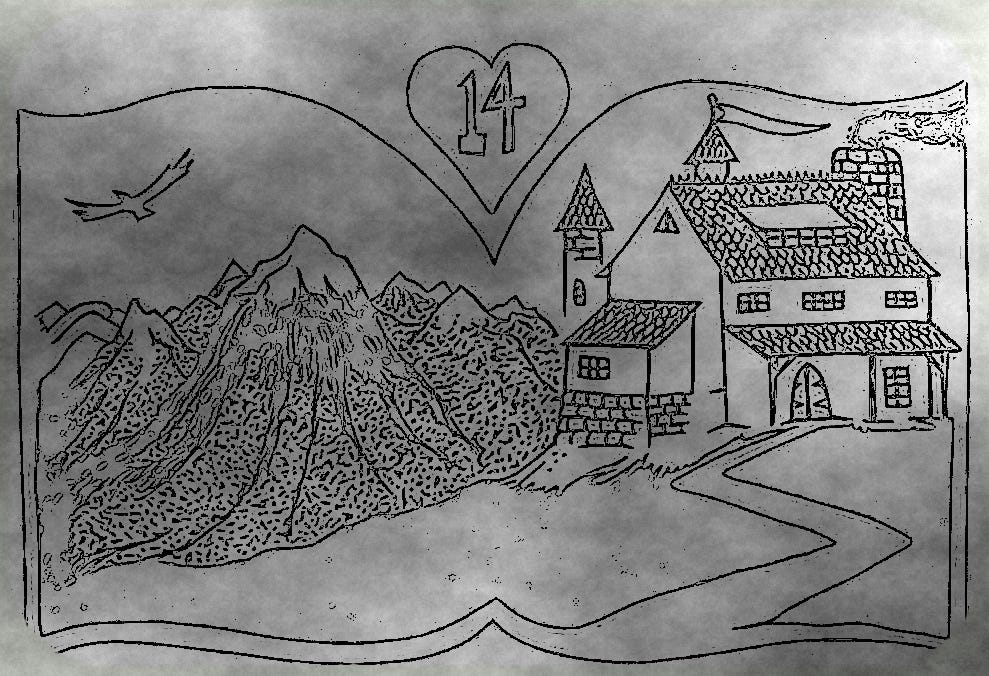
Rendered in crayon on cheap Soviet-era drawing paper, the provenance of the image is unknown, but based on watermarks and technical data, it is almost certainly a c1940s copy of a much older image, possibly from a manuscript. That MSS was conceivably the legendary Matthiaskloster Grimoire, the 300-year-old guest book, inscribed in hundreds of different hands, containing songs, tunes, dedications, remembrances, minor spells, and the like. If the source is correct, it suggests that Hazzard-Igniti, like other Bassanda figures scattered throughout the Correspondence, had actual first-hand knowledge of the Lodge through having visited in person. The only other contents of the manila folder in which this crayon drawing was found in the Archive are a small slip of paper, notated—possibly in Hazzard-Igniti’s hand—reading "Астрахань 1947 - MSS c1642 Matthiaskloster" (The “Astrachan” referenced was a notorious camp on the north coast of the Black Sea). It is thought that perhaps the Doctor himself drew the fragment—possibly even from memory—based upon a much older manuscript (possibly the “c1642” reference) which he had rediscovered but which was lost or confiscated when Hazzard-Igniti was interned in the Gulag some time after 1941.
However, it is also entirely possible that the image is of a completely different provenance, though iconographic analysis is still revealing, regardless of the original source.
The image is consistent with what is known of Matthias’s, particularly its location seemingly well above the tree-line in the northern Alps, and certain aspects of the building’s physical construction: the stone foundations and timbered upper structures reflect its history of having been built upon the rough stone of the much older Matthiaskloster (monastery); likewise, the gigantic double doors at the entrance and the front windows which faced west and south toward the warmer lowlands, and the enormous chimney which was recounted to have been fed with dead-fallen timber killed by dropping temperatures as the tree line crept down to lower altitudes.
The peaks in the center/left background are not positively identified, but it may be that they represent “The Three Brothers” of Bassandan mountaineering legend, based upon the folk-tale “Fi Talat Ixwan”, with the “eldest” and tallest being “Annolungma” (approx. 7900 metres above sea level). The legend of Orla Serdtse Sestry (The Eagle’s Heart Sisters) was said to originate from a mountain village on the slopes of Annolungma, and certainly there are cliffs of the sort described in the transcriptions of that legend found elsewhere in the Archive.
This interpretation is somewhat bolstered by the presence, in the upper-left quadrant, of a crudely-drawn long-winged bird, presumably a raptor: a White-Rumped Vulture, Black Kite, or indeed possibly Asian Golden Eagle. The presence of the bird does not guarantee that the peaks depicted are The Three Brothers or the site of Orla Serdtse Sestry, because in Bassandan iconography it was not at all uncommon to add the depiction of an Eagle to any image which sought to evoke the courage, loyalty, and archetypal feminine power of the Legend, which of course formed the basis for Bronislava Nijinska’s earth-shattering choreography on Xlbt. Op 16, the so-called “Bassandan Rite of Spring” (to the Colonel’s original melody “Out in the Sticks”). So it is ultimately unknowable whether the presence of the Eagle literally connotes that these birds were found in the neighborhood of the Mountain Rest, or whether the artist of the unknown original was rather referencing that folkloric and iconographic metaphor.
Even less certain is the precise meaning of the Arabic numerals “14” contained within an outlined heart at the top center of the image. While the crude crayon frame of the mountain scene vaguely suggests the two leaves of a large open book (this thus supporting the idea that Hazzard-Igniti—if it was in fact he—was referencing the Matthiaskloster Grimoire), the “14” floats above the book, seemingly separate from and free of its connection. We know that Arabic numerals had come to the country by the 13th century CE, as the Liber Abaci of Leonard Fibonacci was well known and a cornerstone of medieval Bassandan mathematics, but the significance of this particular number, and its situation within an outlined heart, is unknown. Certainly numerology was a significant knowledge system within Bassandan scholarship, because of the centrality of mathematical ratios in understanding both the acoustics of sound and the behavior of magnetism, a very important and central phenomenon in the country's geography, geomancy, and electrical technology.
Yet, though the “14” within the heart is unexplained, one theory—a particularly poignant one—has been advanced.
We know that certain iconic images in Bassandan lore have been understood to be both psycho- and/or spatially-active: we have Winesap’s own 1997 account of the very peculiar capacities of original prints by Cifani Dhoma of the “Classic ’52 Band,” and the stories that were subsequently told (though not by him) about how through this image Winesap had come to participate in the “Great Train Ride for Bassanda” (elsewhere in the Correspondence) 90 years before.

It has been posited that perhaps Hazzard-Igniti, some time in the late 1940s, while trapped in the Gelug at the Astrachan camp, might have attempted, using crude materials and only the force of his remarkable memory, to construct a psychoactive image of the Mountain Rest Lodge. Under this theory, the Doctor, working in secret and in conditions of great physical and mental difficulty, would have sought to draw an image of the Mountain Rest, whose accuracy, iconography, and physical technique might render that image capable of human teleportation, as Winesap would later believe of the ’52 Photo. In this interpretation—which is, as we have said, quite poignant—Hazzard-Igniti numbered his attempts at this drawing, possibly as a means of distinguishing between them or, even more starkly, because he was losing the mental capacity to know how many attempts had been made. Hence, he numbered the images as he desperately tried to finish one version that might, through its telekinetic and telemagnetic powers, permit him to transport himself out of the horror of the camps so aptly described by Solzhenitsyn in One Day in the Life of Ivan Denisovich.
It is not recorded or explained how—if indeed the above hypothesis is true—Hazzard-Igniti’s last attempts at rendering the Mountain Rest found their way out of the Gulag and into the compendious collections of the Archive, but the above iconographic interpretation is consistent with other Bassandan art-historical and folkloric scholarship. Sadly, there is no record of the Doctor ever succeeding, as there is in fact no record of where or how he might have died or been buried.
If, on the other hand, as some more fanciful accounts have claimed, there was a successful attempt, e.g.
15,
then this image “14” may represent, not Hazzard-Igniti’s last flickerings of hope for liberation, but in fact, a harbinger of escape and victory. As a slogan emblematic of the hope and courage of the 1970s Bassandan liberation movement commemorated him:
“Shifokor hech qachon noumid”(“The Doctor never despaired”).
**
Footnote:
Rift travel also appears to account for peculiarities in various Bassandan notables’ biographical chronologies: the “Hazzard-Igniti Principle” postulates that “the extension of human longevity is in selective but direct proportion to the preponderance of Rift travel”: suggesting that, all other health and longevity considerations being equal, the more frequently an individual traveled via Rift portal, the longer s/he might be expected to live.[1] And certainly there were both very notable and also lesser individuals in the Bassanda orbit for whom the ordinary rules of human longevity and indeed of aging itself appear to have been very significantly suspended.[2] The Doctor was unable to comprehensively test this hypothesis prior to his apparent disappearance into the Gulag in 1941—which may have occurred in part because the Soviets wished to sequester Rift travel as a potential means for anticipating or even re-writing and accelerating the history of the Marxist revolution—but his senior students continued to investigate in secret.[3] Likewise, various of the Bassandan wisdom traditions, most notably that of the //Iliot// shamans, provided both a cosmological and a surprisingly precise psycho-electrical framework for understanding the cognitive impact of Rift travel, and it is thus no surprise that several of Hazzard-Igniti’s senior students were also initiates and even adepts in those traditions.
**